Listen to
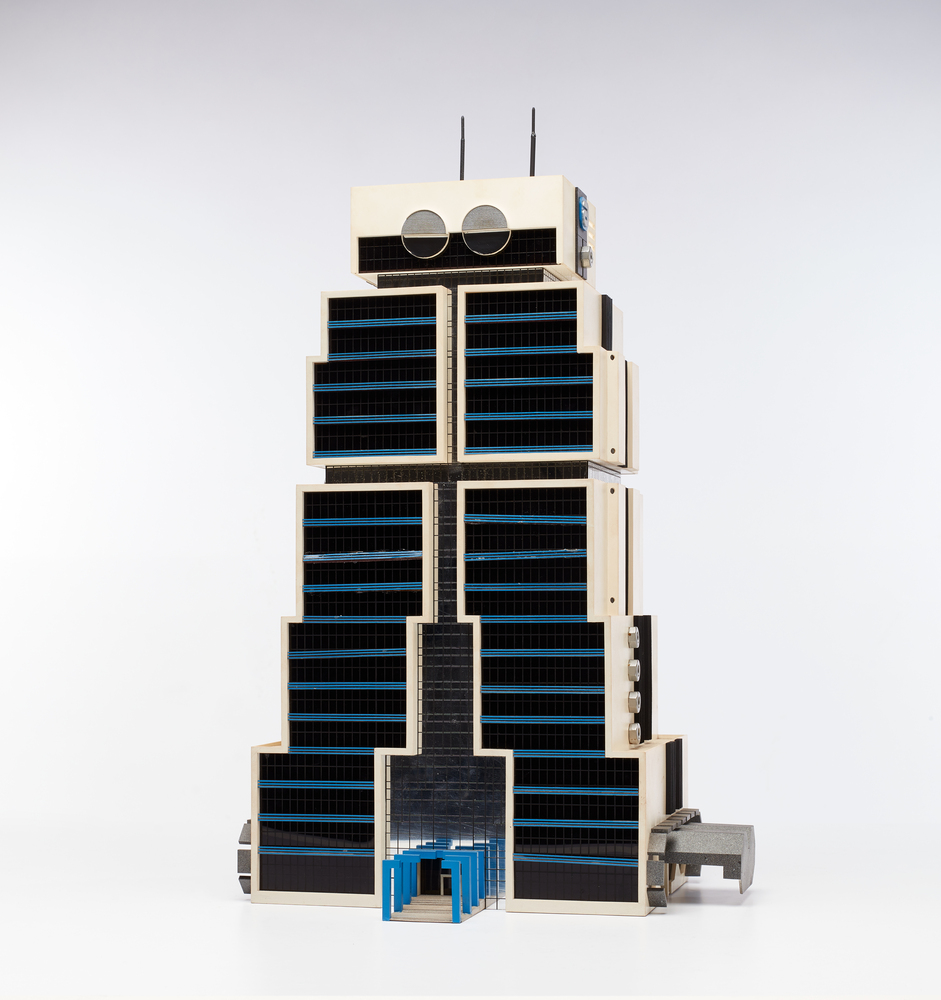
M+, Hong Kong, © Sumet Jumsai. Photo: M+, Hong Kong
Artist Rirkrit Tiravanija shares how he was inspired by the design of this building in Bangkok to create the manga Cities on the Move: Bangkok.
RIRKRIT TIRAVANIJA:
My name is Rirkrit Tiravanija, and I'm an artist.
This comic was a part of a bigger work that was a part of an exhibition called Cities on the Move. Navin Rawanchaikul and myself were invited as artists.
This exhibition was about urbanisation and architecture and how cities are changing and shifting. We were focusing on the urbanisation of Bangkok.
The comic is based on cheap comic books in Thailand. And usually [they’re . . . kind of] more primitive than manga. It was more like strange stories and ghost stories, right? Because those are the kinds of things that are fantastical, and the only way to tell them is by making comics—or film.
The Robot Building was a very prominent building in Bangkok. It was known as the Robot Building because it looked like a giant robot. It was a design by a famous Thai architect, who was actually also an artist. His name is Sumet Jumsai. We very much wanted to bring this giant robot to life.
The idea of invoking this monster that wakes up as a building is kind of Godzilla-ish. I think that was part of why we used that building.
This is a presentation model of the Bank of Asia Headquarters (now United Overseas Bank Bangkok Headquarters) in Bangkok, Thailand. The original building was designed by Sumet Jumsai. It was built in 1983 and completed in 1986. This model was made in 1990. It measures about 52 centimetres high, 31 centimetres deep, and 23 centimetres wide, about the size of a carry-on suitcase. It is made of plastic, synthetic polymer paint, and adhesive.
The model looks like a toy robot. Its broad base supports rows of floors that look like stacked blocks. The blocks are staggered, making the model narrower at the top to define the robot’s head and torso. The facade is blue and black outlined in cream. The sides are cream and black.
Two black lightning rods protrude from the top of the robot building’s head. The eyes are two large round windows placed side by side. The upper halves of the windows are louvred. The lower halves are made of reflective glass. The two halves look like eyelids above a pair of large, sparkling eyes. The robot building’s torso design features a glass curtain wall with alternating blue and black stripes. A black strip runs down either side of the robot building. Metal nuts of different sizes are attached to the surface of the black strips and along its edges. The building’s entrance is located in the centre of the robot’s lower abdomen. Four blue doorframes extend outwards from it. On the bottom left side of the robot building, a row of four large, octagonal windows is shaded from the sun by protrusions that look like an encircling dotted line or a tank track. The windows on the lower right side have a similar design, but two protruding awnings have been added above the middle two windows. The robot building appears to have tank tracks on either side, as if it could move at any time.