Listen to
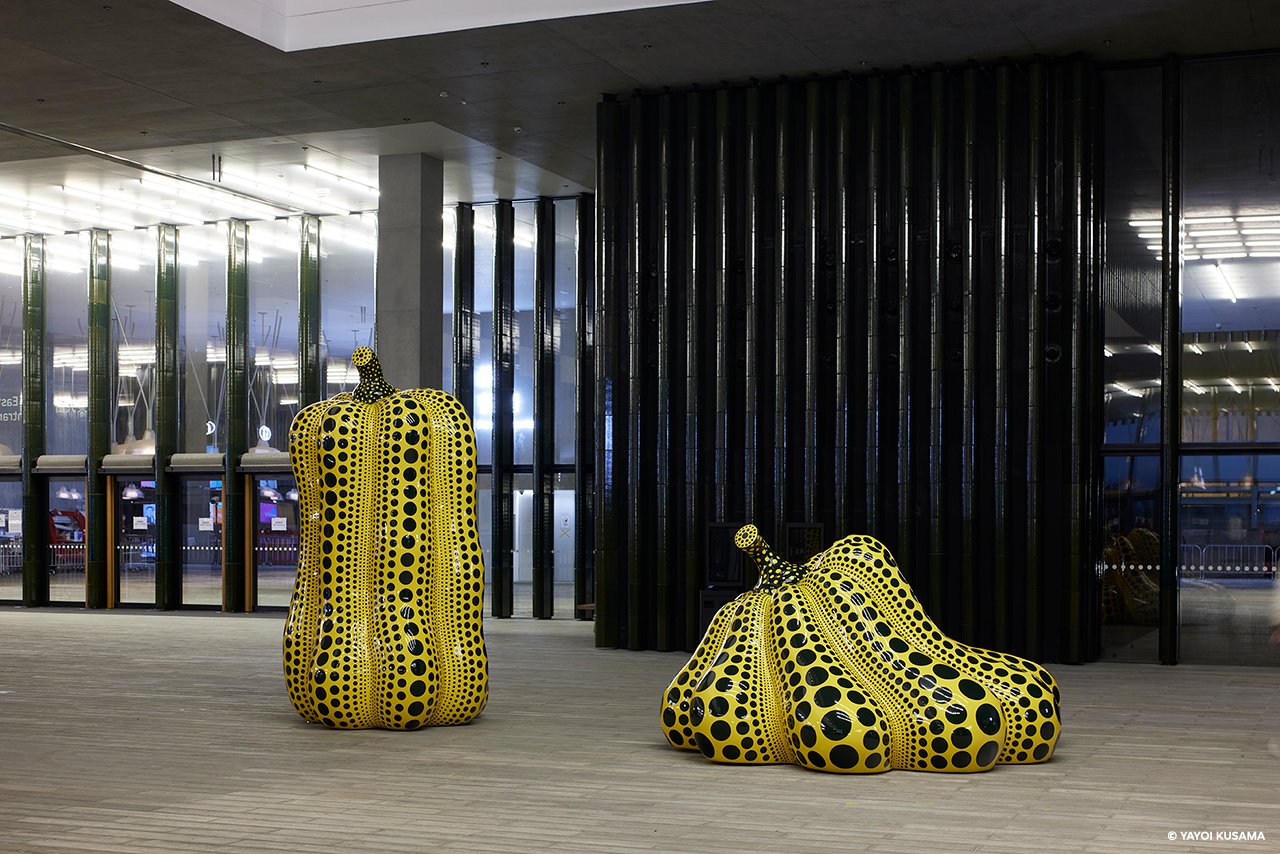
Yayoi Kusama. Pumpkin, 2022. Collection of the artist. Courtesy of Ota Fine Arts.
Doryun Chong:
You may have first come to know Yayoi Kusama’s art by seeing one of her outdoor pumpkin sculptures in person or on social media. Beyond its eye-catching, highly instagrammable polka-dot pattern, the sculpture of an earthy plant captures Kusama’s belief that there is a spirit in every living being and that differences must be embraced and celebrated.
Kusama’s family owned a plant nursery, and she has many childhood memories of interacting with pumpkins. She remembers examining them in the field with her grandfather and seeing the gooey liquid oozing from the stems when she plucked them. She remains fascinated by how pumpkins can be both charming and grotesque.
In the M+ Main Hall, you find two of Kusama’s pumpkins. Black polka dots of varying sizes line the contours of the yellow gourds, highlighting their curves. The taller pumpkin tilts slightly, as if it is slouching gently. The other bulges and flattens at the bottom, as if it is resting.
Just as people come in all shapes and personalities, each one of Kusama’s pumpkins is different in form and features. ‘I love pumpkins’, she has said. ‘What appealed to me most was the pumpkin’s generous unpretentiousness.’ And it is in this sense of unpretentiousness that the pumpkin becomes one of her most recognisable motifs.
Narrator:
This work, titled Pumpkins, is a set of two large pumpkin sculptures created by Yayoi Kusama in 2022. They are made of cast aluminium and polyurethane paint. The pumpkins are of different heights and displayed on the ground next to each other. The taller pumpkin is 300 centimetres high, about 170 centimetres long and 176 centimetres deep. The shorter one is 160 centimetres high, about 284 centimetres long and 272 centimetres deep.
Both of the pumpkins are yellow and covered in black polka dots, but they are differently shaped. The taller pumpkin is slender with a cylindrical structure, while the shorter pumpkin is flat and wide. The shorter pumpkin has a narrow top and gradually grows wider towards the bottom, until the bottom is about twice the width of the top. This makes the shorter pumpkin look as if it is melting.
The pumpkins are lined with vertical indented ridges. Each pumpkin has about seven to eight ridges. The black polka dots on the pumpkins vary in size. They are largest on the raised surfaces and become smaller towards the sunken areas in between each ridge. The largest dots are the size of an adult's palm, while the smallest dots are only the size of a fingertip.
Each pumpkin has a thick cylindrical stem at the top. The diameter of the stem is as long as the top edge of a piece of A4 paper in portrait orientation. The stem is also polka-dotted, though its colours are inverted—yellow dots on a black background—compared to the rest of the pumpkin.