Listen to
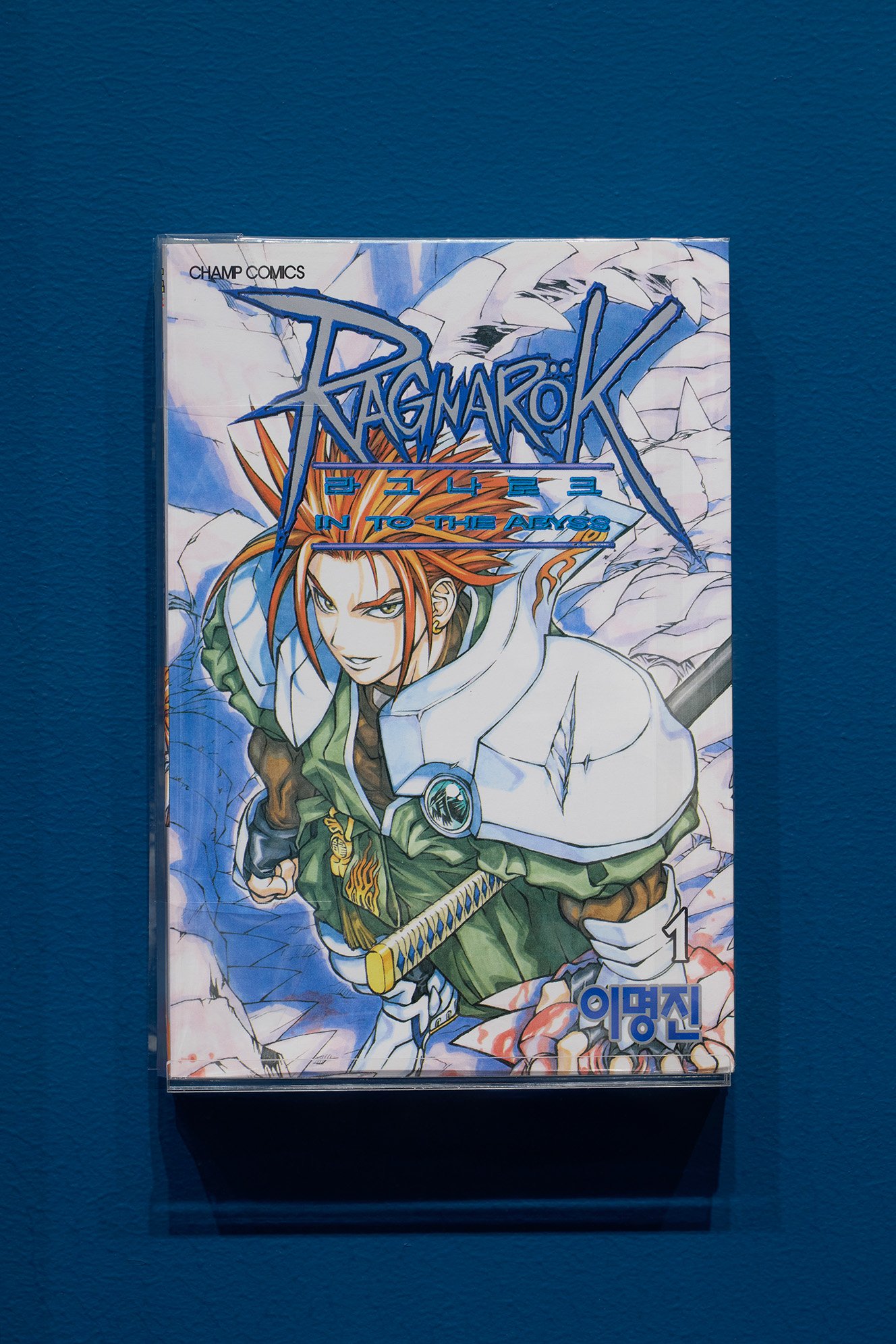
Installation view of Myths and Monsters: The Art of Fantasy in Asia, 2026. Photo: Lok Cheng, M+, Hong Kong
SOOKYUNG YOO:
My name is Sookyung Yoo. I'm a faculty member at Kyoto Seikan University, and I also work at the International Manga Research Center.
Manga refers specifically to comics that developed in Japan in close connection with Japanese media culture. While manga shares the fundamental characteristics of comics, many manga works have distinctive qualities you don't often find [in] other comics. For example, [the way] panels are used to express interiority.
When people talk about manga's global popularity, the examples that tend to come up are from Europe and North America. But actually, in East Asia, in places like Korea and Taiwan, even Hong Kong, manga has a much longer history.
All around the world, non-Japanese mangaka, so manga artists, have emerged. They use manga's visual language and narrative style to tell their own stories. And some draw fantasy works that aren't tied to any particular nationality or region. Others use the manga format to tell stories rooted in their own culture. In Africa, for example, you can find artists expressing local mythology and social issues through manga.
From the 1990s onwards, French-translated manga and anime spread into Francophone Africa, while Spanish-translated manga and anime found a large audience across Latin America.
What I find fascinating is that each region transforms manga through its own cultural filter as it absorbs it.
Ragnarök, volume one, is a work by illustrator Lee Myung-jin. It was published by Daewon C.I. in 1998. The paperback book is about 26 centimetres high and 18 centimetres wide.
The cover is printed in colour. It depicts the main male character Chaos. He is dressed as a warrior and shown from a high, forty-five-degree angle perspective. The comic’s title, Ragnarök, appears at the top of the cover in bold, spiky type, as if engraved by a knife. Beneath the main title is the Korean transliteration and the English subtitle ‘Into The Abyss’. In the top left corner, the English words ‘Champ Comics’ indicate the name of the comic magazine imprint published by Daewon C.I. The numeral ‘one’ is printed in the lower right corner, indicating this is volume one of the series. Below it is the author’s name, Lee Myung-jin, in Korean script.
The character shown on the cover looks young. Short spikes of orange-red hair rise from his head like a flame. His eyebrows are also orange-red and arch upwards. He looks at us with a penetrating gaze and a sly smile. He has a strong, muscular build. He is wearing sturdy white shoulder armour. A deep gouge on the armour’s left side looks like it was made by a sharp blade. Under the shoulder armour, he is wearing a wrinkled green warrior gown over a tight brown bodysuit that reveals his muscular chest and arms. His forearms and legs are protected by white armour, and he carries a long Japanese sword at his waist on the left side. The character seems to be surrounded by the tail and body of a gigantic white monster, which is covered in spiky scales. The character clutches one of the monster’s claws in his left hand. The bloodstained claw was broken off in combat, giving the scene a sense of great tension.