Listen to
M+, Hong Kong, © Okanoue Toshiko
ISABELLA TAM:
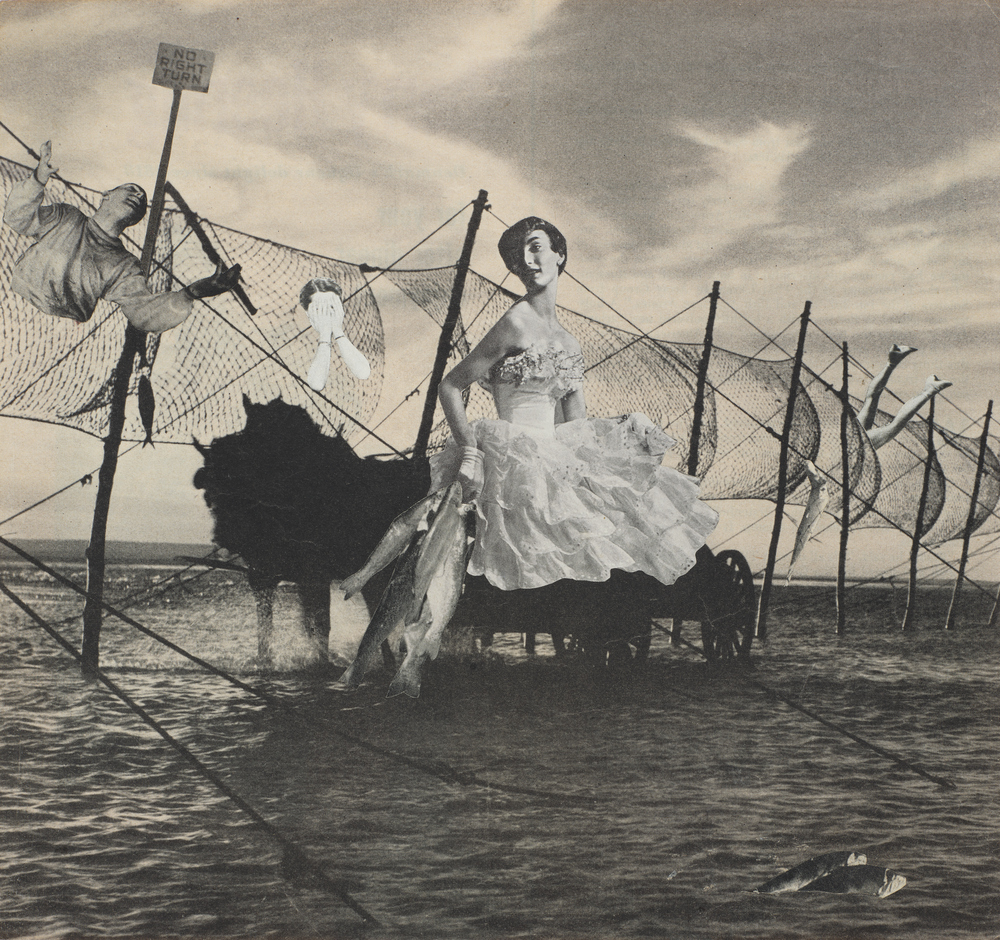
My name is Isabella Tam. I am the Curator of Visual Art at M+, and also a co-curator of this exhibition, Myths and Monsters: The Fantasy of Art in Asia. This work is called Kill, made in 1955 by the Japanese artist Okanoue Toshiko.
After World War II, American consumer goods and popular culture spread across Japan. Okanoue had access to magazines like Vogue and Harper’s Bazaar, exposing her to the latest fashion trends. The artist took different pieces from these magazines to create this photo collage.
Okanoue had a very short career. She was an aspiring fashion designer, but she only practised art from the early 1950s until 1956. This work was made towards the very end of her career. After that, she became a wife. She was very frustrated by the social expectation that she had to be a housewife and mother, and that she had to abandon her artistic pursuits.
Okanoue was projecting her ideal image or her ideal career path onto this image, in contrast with the reality that she was experiencing. This photo collage gives the impression that you are looking at a very beautiful woman, but there are a lot of contradictions in it. While the woman in the middle seems to be hopeful, we see fragmented bodies and sad faces behind her.
Many artists, including Okanoue, were practising Surrealism in their own context. Artists can do a lot of experimentation in the dark room to create this sort of very surreal image. And because the images are small, they could also be circulated very easily. Photography created this grey zone for artists to express their anxiety, their emotions, or even to respond to the reality of that time.
Okanoue Toshiko created this print collage called Kill in 1955. She used images from fashion and lifestyle magazines and a halftone letterpress technique. The monochromatic work is 25 centimetres high and 26 centimetres wide.
The setting for this work is the shallow water of a sea-coast. Two horses pull a wagon through the water. The young woman seated in it looks over her shoulder towards the upper left side of the image. Several fish leap out of the water to nibble at her glove and the skirt of her dress. Behind the woman is a row of wooden poles with fishing nets stretched between them. Atop the leftmost wooden pole is a sign that says ‘No Right Turn’. Caught in the nets between the poles are pieces of human bodies. To the far left is the head and torso of a person with arms spread wide, head tilted back to look up at the sky. Nearby, another person covers her disembodied face with her hands. To the far right, a pair of bare legs in high-heeled shoes sticks out of a net, pointing towards the sky. The young woman in the centre, leaping fish, and fragments of people are clearly delineated, making it obvious that these images have been cut and pasted into the collage. The entire scene is a gloomy ochre tone.
As we take a closer look at the centre of the image, we notice that the young woman is bigger than the wagon, which is silhouetted against the lighter background. The woman is slim and has short, cropped hair. She is wearing an elegant, strapless white gown with ruffles layered around the bust and skirt, in the style of the 1950s and 1960s. She gracefully lifts her gown as she looks over her shoulder to the left. She appears composed and detached, as if unaware of the big fish that have leapt out of the water to nibble at her glove and elaborate skirt. Her white gown creates a strong contrast with the dark wagon, drawing the eye to the centre of the image.
The ragged edges of the clouds stretched across the sky like long tufts of cotton and the billowing nets between the poles suggest that a strong wind is blowing. This impression of turbulence combined with the stillness of the other images creates a somewhat bizarre scene full of unease.