Listen to
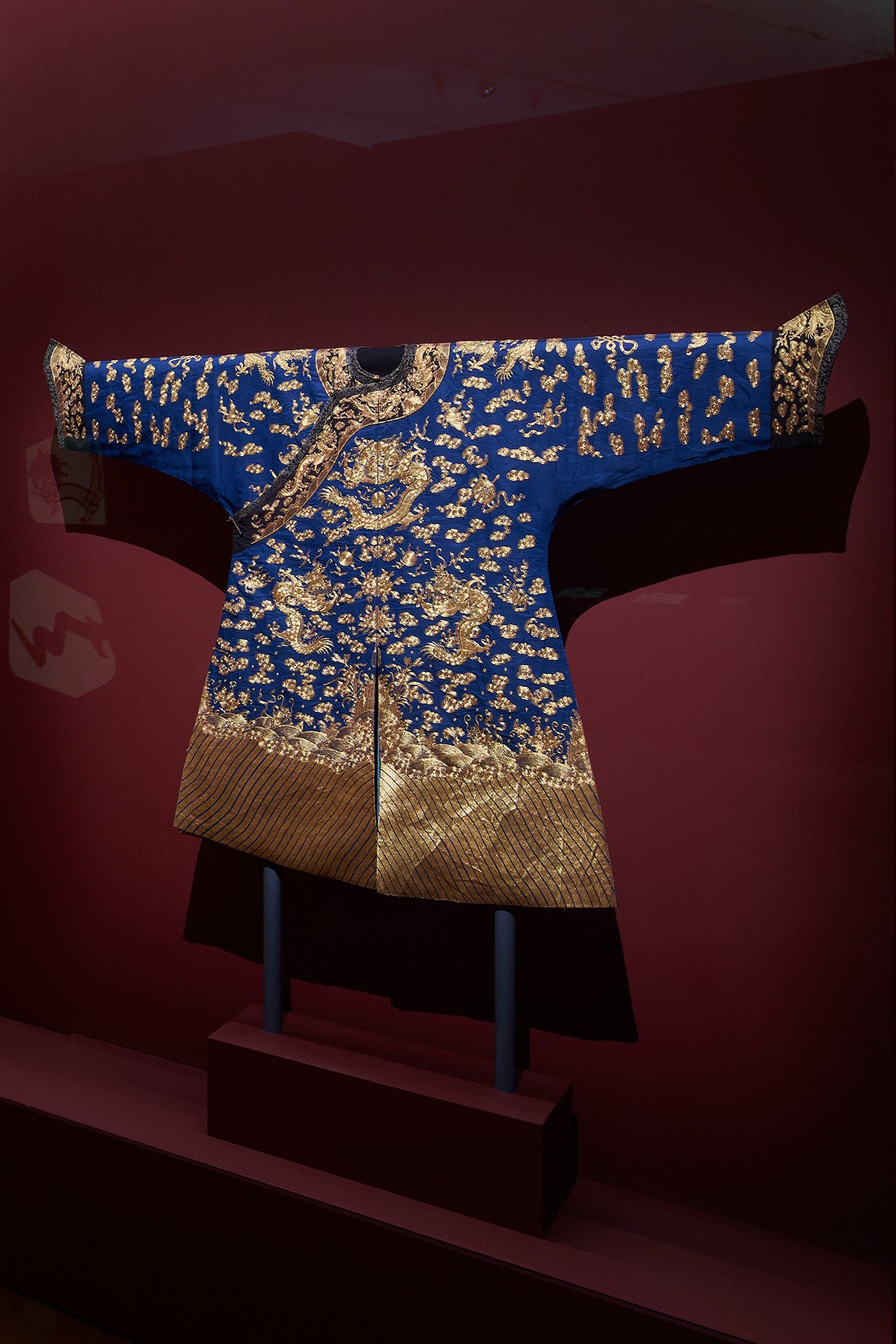
Installation view of Myths and Monsters: The Art of Fantasy in Asia, 2026. Photo: Wilson Lam, M+, Hong Kong
CHRIS HALL:
My name is Chris Hall. I am the owner of this dragon robe and have a large collection of antique Chinese textiles. This is a traditional Chinese dragon robe.
When I bought the robe, I was told that it was made for Pu Jie, the brother of Pu Yi, the last emperor. The robe symbolises the universe. The diagonal stripes at the bottom represent the sea with the land and mountains appearing above. Above them is the sky with dragons flying among the clouds chasing the pearl of wisdom.
The dragon is a powerful creature. It is also benevolent and protects his people, so the dragon is a suitable symbol for the emperor.
Most dragon robes for the emperor and officials have nine dragons, three on the front, three on the back, two on the shoulders, and one on the inside flap. This makes a total of nine, which is an auspicious number. This robe has only eight dragons. It is missing the dragon on the inside flap. This indicates that it was not made for someone who was an emperor or an official but for someone who was neither, such as a young boy or a young prince.
This blue and gold robe is a nineteenth-century textile product made by an unknown craftsperson. It is made of silk. The robe measures about 75 centimetres from the collar to the hem and about 60 centimetres across the bottom.
The robe probably belonged to a thirteen-year-old Chinese boy in the imperial family. It features a round collar and large lapels that fasten on the right with gold-thread frog closures. The garment has horse hoof cuffs and bottom slits on four sides. The dark blue fabric is embroidered in gold thread with a pattern of four-clawed dragons, clouds, rivers, and mountains.
The collar and cuffs are decorated with double bands of azure-blue trim. The first band is narrower than the second band. It is embroidered with flowers and gold coins, representing good fortune. The second band is about four times as wide. It is embroidered with gold dragons soaring above iridescent clouds. The sun and sea waves can also be seen in the pattern. A gold dragon is embroidered over each of the robe’s shoulder seams. Three more gold dragons adorn the front: one at the centre-top of the lapel and two on either side below it. The large dragon in the centre faces to the front. It has a firm, snaky body and fan-shaped scales. The dragon seems to growl at us as it flexes its strong claws. The two dragons below it face left and right. Their long whiskers curl upwards, representing the energy of the dragons flying high among the clouds. Embroidered around the dragons are patterns symbolising good fortune, such as fire, clouds, flowers, and bats. A fan-shaped pattern of waves is embroidered at the robe’s bottom. Two dragons splash in the waves on the left and right. Underneath, two sets of symmetrical oblique lines point downwards from the central front slit.
The gold embroidery on this robe demonstrates the great skill and precision of its maker. Even in soft light, the robe’s dynamic patterns seem to shine.