Listen to
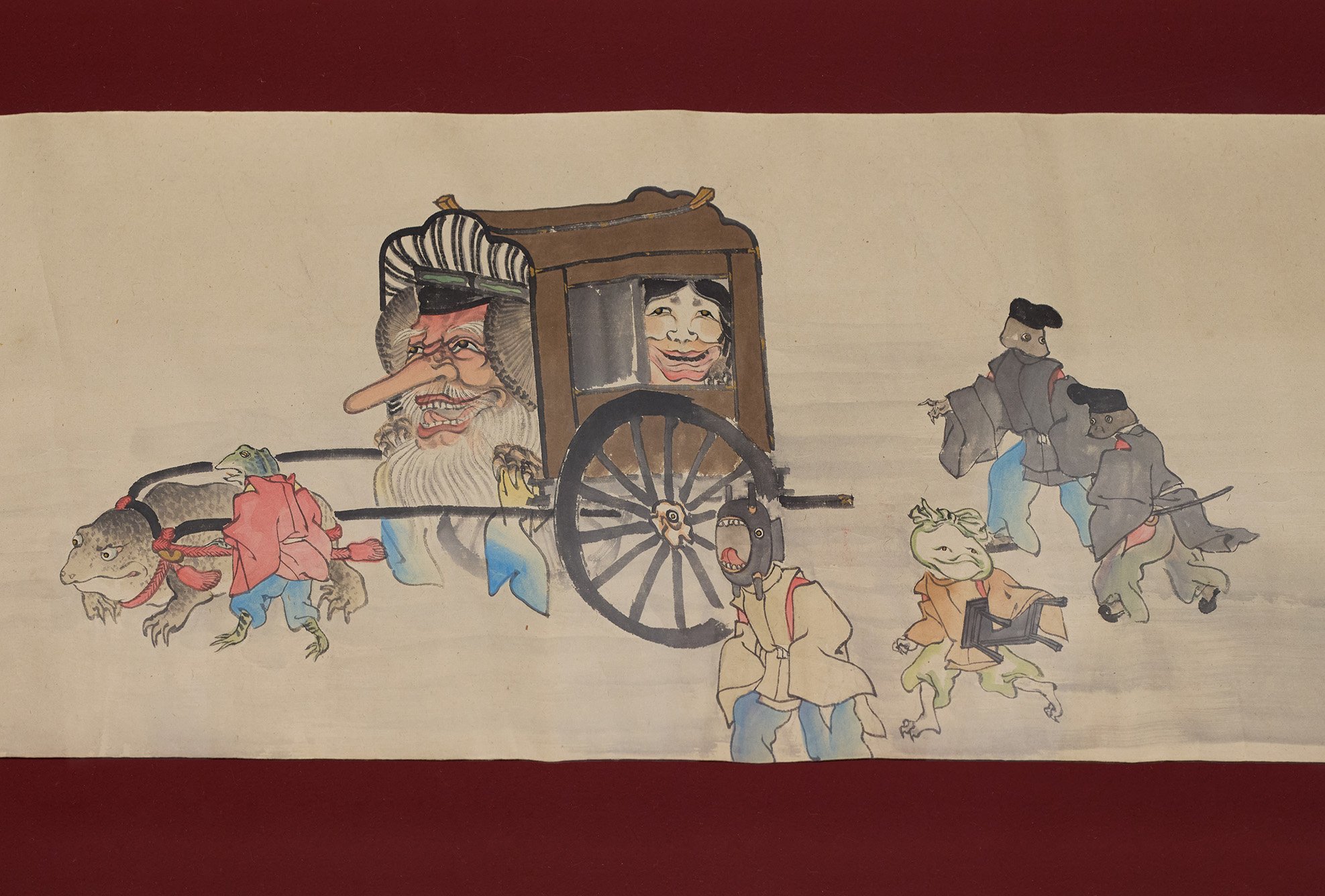
Installation view of Myths and Monsters: The Art of Fantasy in Asia, 2026. Photo: Dan Leung, M+, Hong Kong
Professor Yumoto Kōichi is honorary director of the Yumoto Koichi Memorial JAPAN YOKAI MUSEUM, also known as the Miyoshi Mononoke Museum.
(ACTOR’S VOICE) YUMOTO KŌICHI:
In Japanese culture, there are stories about encounters with strange, demon-like creatures marching through the dark. These processions are known as the Night Parade of One Hundred Demons. The demons are supernatural beings called yokai.
What exactly are yokai? There is no simple definition. Even if we asked a hundred researchers, they would not all agree.
Some people believe everything has a spirit, even objects. For example, after we use a desk, a computer, or a chair for many years, it can develop a spirit. In this depiction of the Night Parade, we see a gathering of discarded household items. They have faithfully served human beings, only to be thrown away. They join forces to take revenge, causing mischief. The objects turn into yokai.
Broadly speaking, yokai come from people’s fears about nature, their inner anxieties, and their sense that something unseen is stirring in the darkness.
The dark played a bigger role in our ancestors’ everyday lives than it does in ours today. At night, stepping outside could leave someone in complete darkness. People could easily imagine another realm that existed next to ours, and that something in it was moving.
In the past, human beings had little control over natural disasters, epidemics, and other misfortunes of this kind. People often had no choice but to wait for such things to pass, or to pray that they might be avoided.
These experiences gave people a sense of powerful forces beyond human understanding. Gradually, the idea of yokai took shape.
This handscroll is called Night Parade of One Hundred Demons. It is a work in coloured ink on paper by the artist Unkei, who was active in Japan during the Edo period (1603–1868). The scroll measures about 32 centimetres high and almost 600 centimetres long, about the size of six doors placed side by side.
As the handscroll is unrolled from right to left, we can see a parade of strange, demon-like creatures, known as yokai. They are marching along a main street after sunset. Yokai come in all shapes and sizes. Some of them are everyday objects, such as work tools, folding fans, and musical instruments. These objects transform into their yokai forms after dark, seeking revenge on the humans who discarded them. The exhibition shows the full handscroll in three sections, displaying its beginning, middle, and end sections in rotation.
In the middle section of the handscroll, a huge toad is harnessed to a two-wheeled wooden carriage, doing its best to pull it. A large frog standing next to the toad seems to be helping it. A giant human head juts out from the front of the carriage. The head belongs to an old man called Tengu, also known as Heavenly Dog. He has a red face, a long nose, eyes shaped like half-moons, and cheeks hidden under long white whiskers. Tengu beams with excitement and laughs aloud as he clutches the carriage door with his huge claws. Through the carriage’s side window, we can see the big, broad face of a woman. She looks out at us with a grin. Four yokai follow the carriage on foot. They are wearing traditional Japanese clothing and appear to be in a hurry. One of them has a black frying pan for a head, with a hole in it that looks like an open mouth. Behind these four yokai we see the ruined forecourt of a roadside temple. Several yokai are inside the temple. Among them are a candlestick yokai, a red-faced wooden fish monster, a one-eyed fly-whisk, and a Japanese bamboo trunk with claws.
Many other noteworthy yokai appear in the parade. One has a head like a teapot and rests its left hand on its hip. It walks on two feet like a human. Another resembles a Japanese zither, or koto, with broken strings. It has bare, clawed feet and crawls on all fours like an animal. The detailed lines used to draw the yokai’s clothing give them a ruffled appearance, creating an impression of quick movement that gives the work a lively air.