Listen to
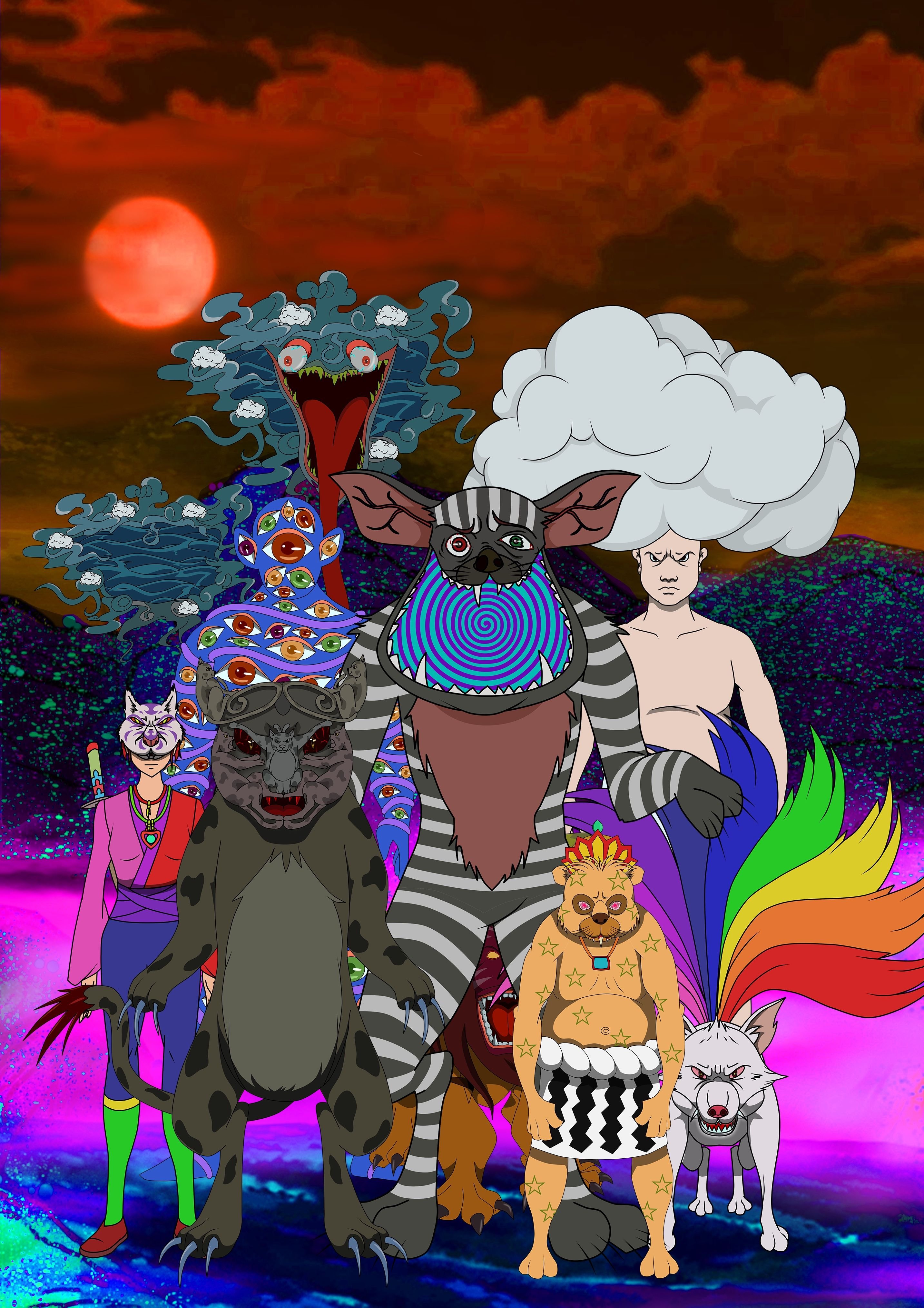
© Ho Tzu Nyen
HO TZU NYEN:
My name is Ho Tzu Nyen. I'm an artist living and working in Singapore.
Night March of Hundred Monsters is a project I made in 2021. It attempts to splice Japanese yokai with intellectual histories in Japan during the Second World War.
Yokai refers to special categories of beings, something between monsters or spectres. We see yokai in the earliest scrolls, from centuries ago. But closer to the modern period, yokai started appearing in ukiyo-e prints, which were mass distributed. These prints have a direct connection to the birth of manga and anime in Japanese culture. Many of these characters from manga and anime actually are variations of yokai in different forms.
I tried to invent a few new yokais. One is called the ‘Tiger of Malaya’. He was a Japanese man who was born in Malaysia [then Malaya]. Due to a family tragedy, he became an outlaw. He was said to rob the rich and eventually became known as the ‘Tiger of Malaya’. But my ‘Tiger of Malaya’ can transform into another person, General Tomoyuki Yamashita, who led the Japanese Army that conquered Malaysia [then Malaya] and Singapore at the outbreak of the Second World War. General Tomoyuki Yamashita was widely known as the ‘Tiger of Malaya’, same as the robber.
When I started to work as an artist, I never thought of myself as someone who was interested in history. I simply thought of myself as someone who wants to understand my world—why it is sometimes so beautiful, and why it is often so brutal and absurd. The only way I could understand my present was to try to understand how things led to this moment.
This work is titled Night March of Hundred Monsters – 36 Mini Ghosts. Ho Tzu Nyen created the approximately twenty-minute single-channel animation with colour and sound. It is narrated in Japanese, with subtitles in Chinese and English.
The animation is projected onto a sheet of glass set inside a wooden structure, which resembles a puppet theatre or a mid-century television cabinet. Four long, smooth wooden legs support the cabinet. The legs are wider at the top with narrower tips at the bottom. The cabinet is 150 centimetres wide, 90 centimetres high, and about 103 centimetres deep, about as wide and tall as a washing machine and clothes dryer placed next to each other. Including the legs, the wooden cabinet is about as tall as an adult.
The animation features thirty-six colourful yokai. Most are monsters, spirits, and demons from traditional Japanese folklore. Among them are some classic characters, such as the shape-shifting fox, river-child, lantern ghost, and earth spider. As each ghost appears, a narrator says its name.
The animation begins in darkness. A suspended Japanese lantern slowly emerges at the centre of the screen. The lantern lights up with a crackling sound and the flickering flame brightens. Brown hair grows from the lantern’s top ring, and a face sprouts on the shade below. The lantern ghost has a wrinkled forehead, a big nose, and a pair of wide eyes. Its drooping eyelids make it look sleepy. A wisp of white smoke floats around the lantern and the chime of a bell can be heard in the background. The lantern grows larger and transforms into a ghost wearing a purple gown. The ghost’s body is purplish red. It is bald, and one of its eyes is higher than the other. It has large ears, sharp teeth, and four pairs of arms and legs that it waves menacingly. Its body transforms again into the head and upper body of an eight-legged spider. The ghost’s human face becomes the spider’s bulbous abdomen. This is the ever-changing earth spider that lives in a burrow underground. The spider releases liquid silk from its spinnerets and makes a web. Blinking its six eyes, it ejects flames that destroy the web. The earth spider is then followed by other yokai, appearing one after another.
The dim lighting in this area of the exhibition makes the television screen the only source of light, so that the yokai in the animation appear to be inside a mini theatre. The screen darkens when the animation ends, and lights illuminate the four sides of the wooden cabinet’s inner frame. Spotlights shine from above, allowing viewers to see their reflections in the glass.