Listen to
©2023-2024 Takashi Murakami/Kaikai Kiki Co., Ltd. All Rights Reserved.
(ACTOR’S VOICE) TAKASHI MURAKAMI:
My name is Takashi Murakami, and I am a contemporary artist.
The ‘Four Symbols’ in these paintings are divine beasts said to have originated in ancient China, derived from mythology and astronomy.
It is believed that the East is guarded by the Blue Dragon, the West by the White Tiger, the South by the Vermilion Bird, and the North by the Black Tortoise.
In feng shui, landscapes direct the flow of qi, or energy, and a piece of land with these four mythical beasts positioned around it is considered the best possible site.
It is said to ward off evil energies and attract blessings such as wealth, good health, and longevity.
Since I am Japanese and have been strongly influenced by manga and anime, I use manga-like imagery and anime-like visuals—there’s no other particular reason behind it.
As I see it, in regard to what I want the viewer to think about when they are standing in front of my work, it’s the same message as what a foreign tourist, for example, might receive when visiting a shrine or temple, and they see an image of a dragon or a tiger—that is, the assumption that these are animals taken from a mythological context.
For me, as a contemporary artist, it all hinges on a single point: whether a mechanism is working for the viewer.
So, there is the painting, there is the viewer, and whether an abstract dialogue can take place between that viewer and the painting—that is the crux of the matter, the key point.
Whatever techniques or content we use to create the mechanisms that facilitate this dialogue are, in a sense, secondary.
I believe the most important thing is that the viewer is there, standing in front of the painting, and becomes fully immersed in it.
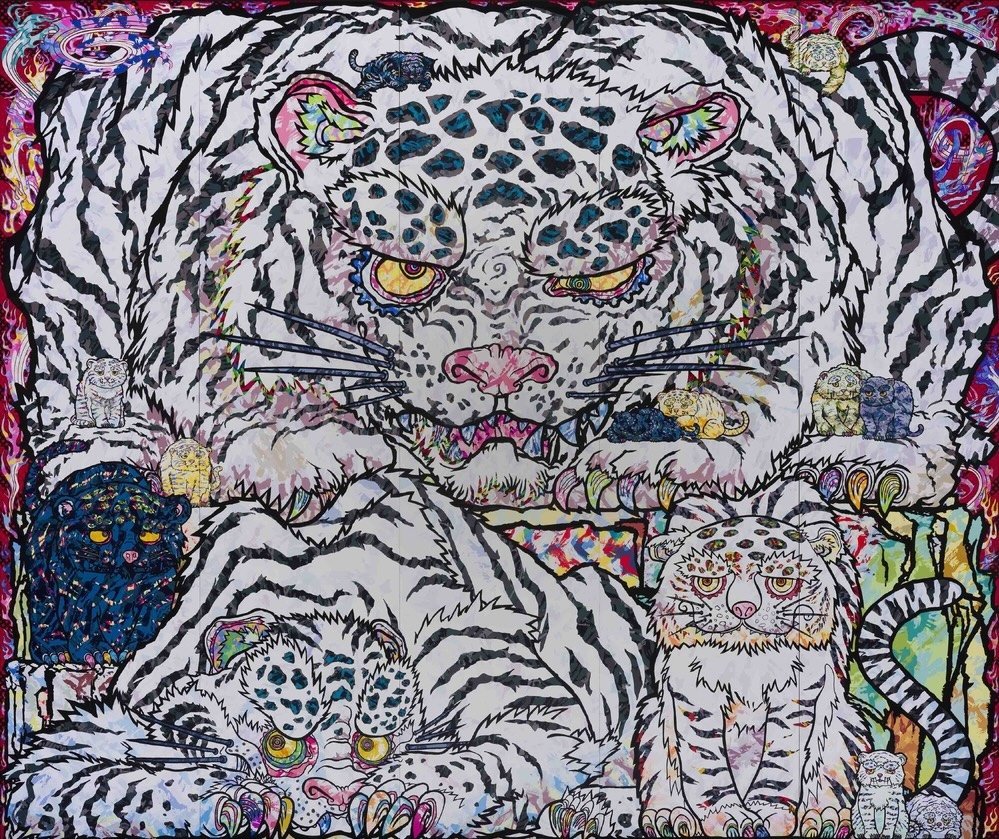
This work is called White Tiger and Family. Takashi Murakami created it in 2024 using acrylic paint, glitter, and gold leaf on canvas. Displayed in landscape orientation, it measures 180 centimetres high and about 214 centimetres wide, about the size of three doors placed next to each other.
In this painting, the White Tiger, a mythical beast in East Asian culture, is shown with its family. Looking at the painting from a distance, we see three white tigers with black stripes. If we move closer, we notice many smaller tigers in different colours and postures perched on and around the larger ones. A total of fourteen tigers are in the painting.
The largest tiger occupies the top half of the painting. It seems to be crouching on a large, colourful rock, its head resting between its exposed claws. One of its dense, hairy eyebrows is raised higher than the other. Under the higher brow, the eye gazes upwards; under the lower brow, the eye looks downwards, giving the tiger a vigilant expression. The mouth is slightly open, showing its sharp teeth.
Two smaller tigers fill the bottom half of the painting. They are half the size of the largest tiger, positioned next to each other on the left and right. The tiger on the left crouches close to the ground, its back hunched like a mountain. Its eyes look towards the left, giving it a curious expression. The tiger on the right is sitting upright. It seems to be looking at us with a mischievous smile.
The rest of the tigers are spread out around the three main tigers. Most of them are much smaller. They sit near or on the larger tigers’ heads, shoulders, and paws. These eleven small tigers are all posed differently. Some are sitting or crouching; others cuddle quietly in pairs. A dark blue, speckled tiger sits on the left side of the painting. It is almost the same size as the largest tiger’s front paw. It is looking up, as if rolling its eyes impatiently. The other ten tigers are white, dark blue, light yellow, and light purple.
The rich use of colour and flattened perspective in this scene is accentuated with glitter and gold leaf. These materials add vibrant colour to the tigers’ facial features, teeth, and claws, as well as the painting’s background. They also stand out against the the white body of the largest tiger, creating a vivid contrast.
White Tiger and Family is displayed with three other works by Takashi Murakami from the same series. Each represents one of four mythical beasts. These are the Blue Dragon of the East, the White Tiger of the West, the Vermilion Bird of the South, and the Black Tortoise of the North. Murakami has painted these mythical beasts with vivacious, sometimes exaggerated expressions that might remind us of manga characters.